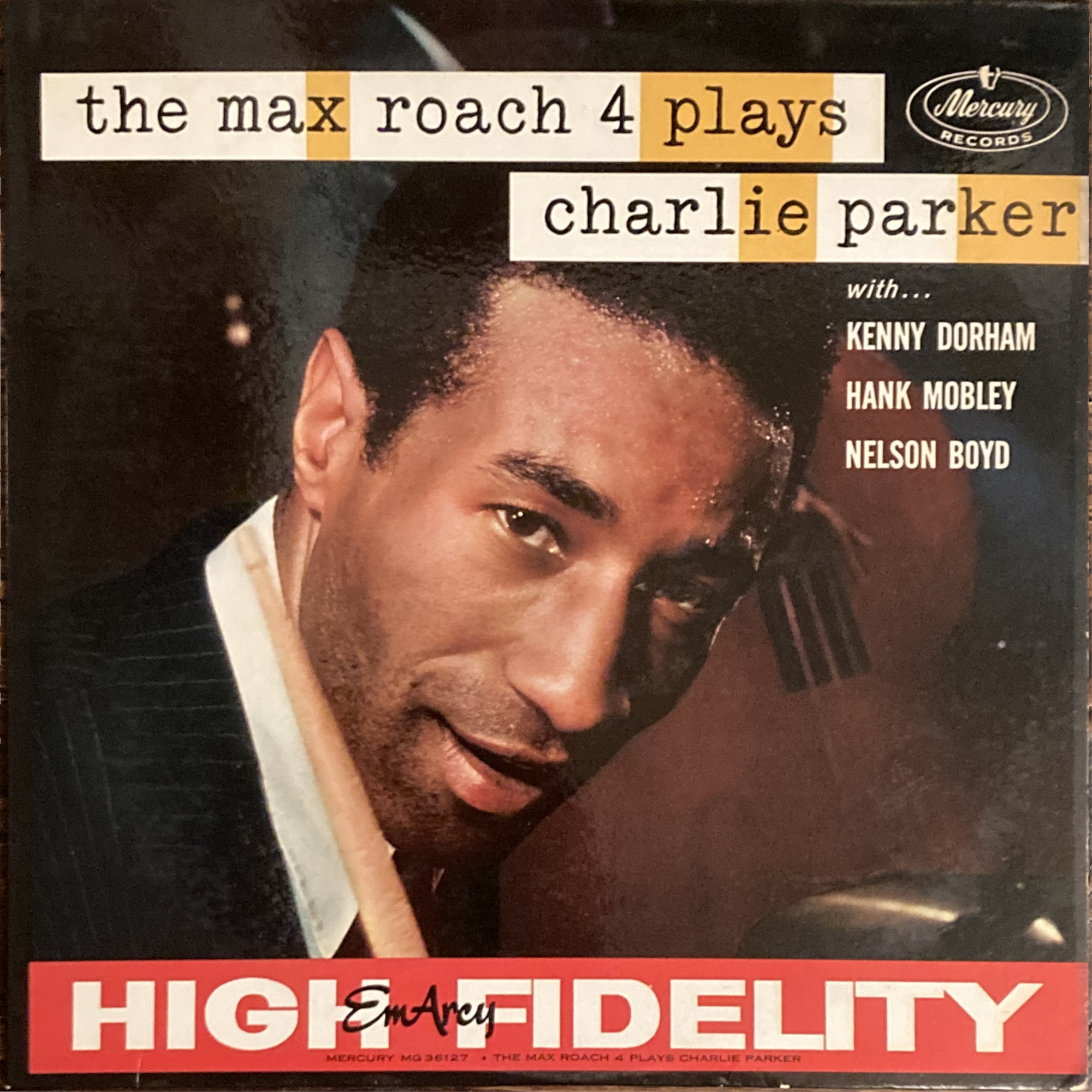
Label: MERCURY
No.: MG-36127
Title: the Max Roach 4 Plays Charlie Parker
Musician: Max Roach (4)
Recorded: 1957/12/23, 1958/4/11
Monaural
Cover address: None
Coating有り
Groove Guard
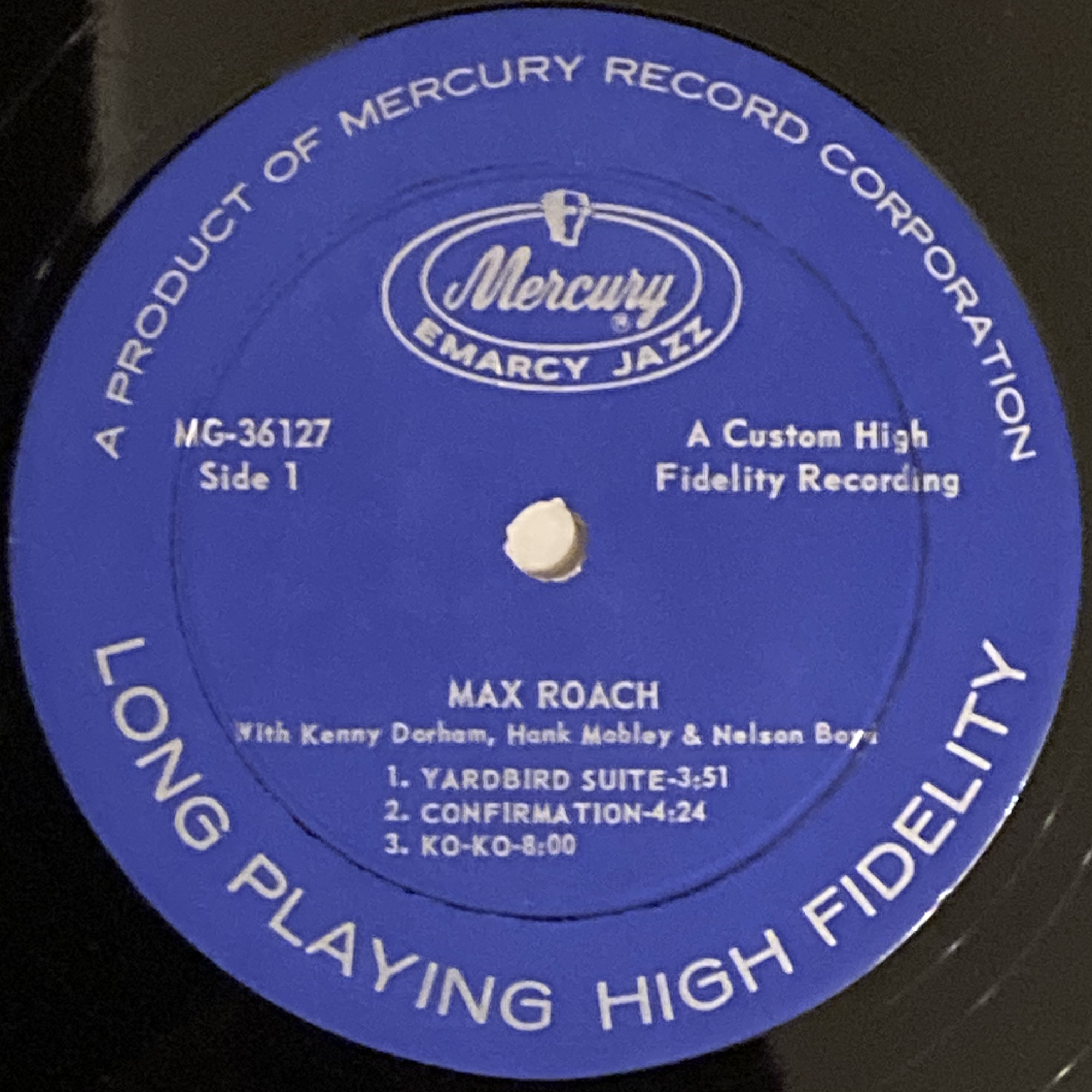
Label Side-1
Blue Background
Silver Letter
Address:
Deep Groove
Dead Wax Info: MG-36217-A-2
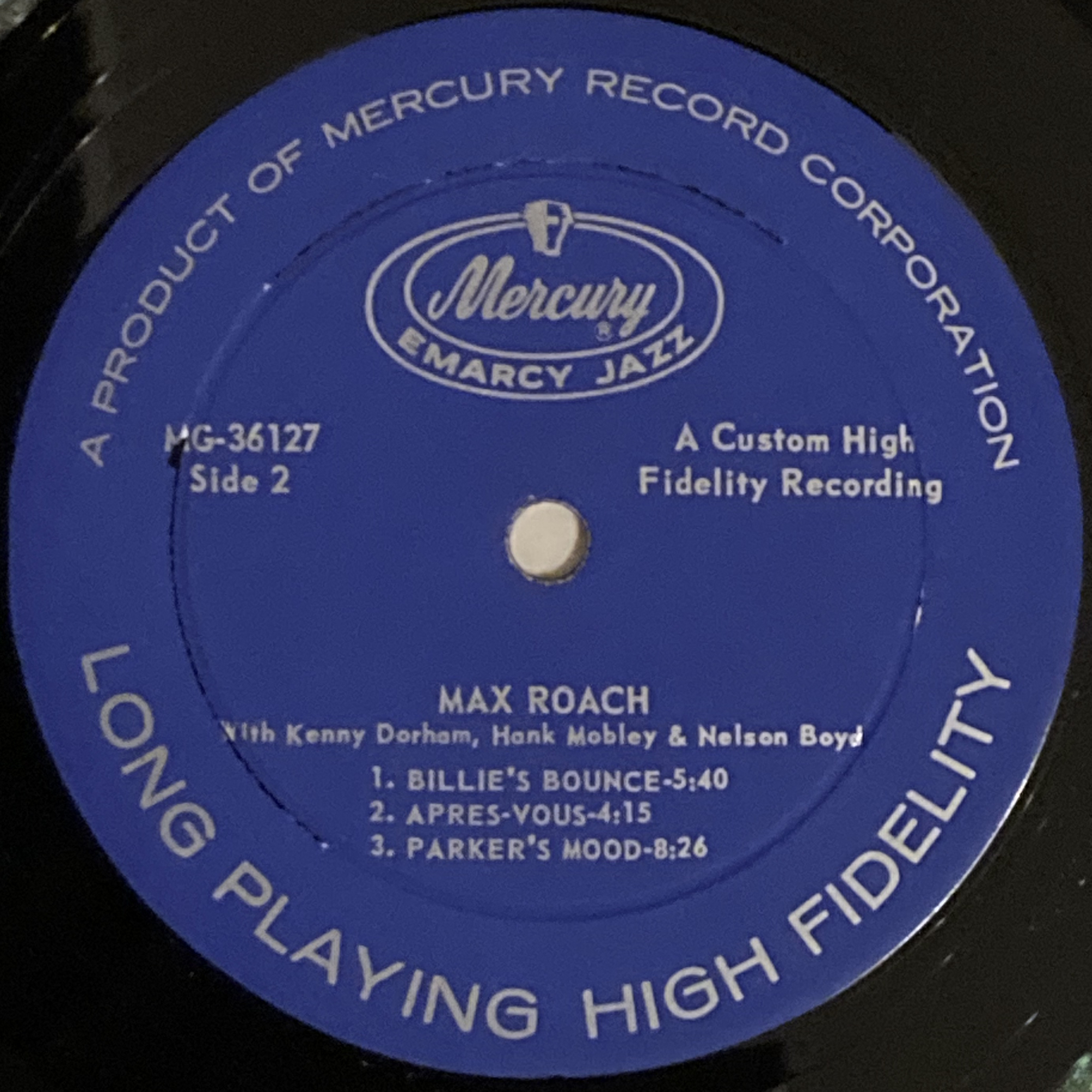
Label Side-2
Blue Background
Silver Letter
Address:
Deep Groove
Dead Wax Info: MG-36217-B-1
Personnel- (Side1-1,2& Side2-2 1957/12/23)
Drums: Max Roach
Bass: George Morrow
Tenor Sax: Hank Mobley
Trumpet: Kenny Dorham
Personnel- (Side1-3& Side2-1,3 1958/4/11)
Drums: Max Roach
Bass: Nelson Boyed
Tenor Sax: George Coleman
Trumpet: Kenny Dorham
Tracks-
Side-1
1) Yardbird Suite 3’51”
2) Confirmation 4’24”
3) Ko-Ko 8’00”
Side-2
1) Billie’s Bounce 5’40”
2) Apres-Vous 4’15”
3) Parker’s Mood 8’26”
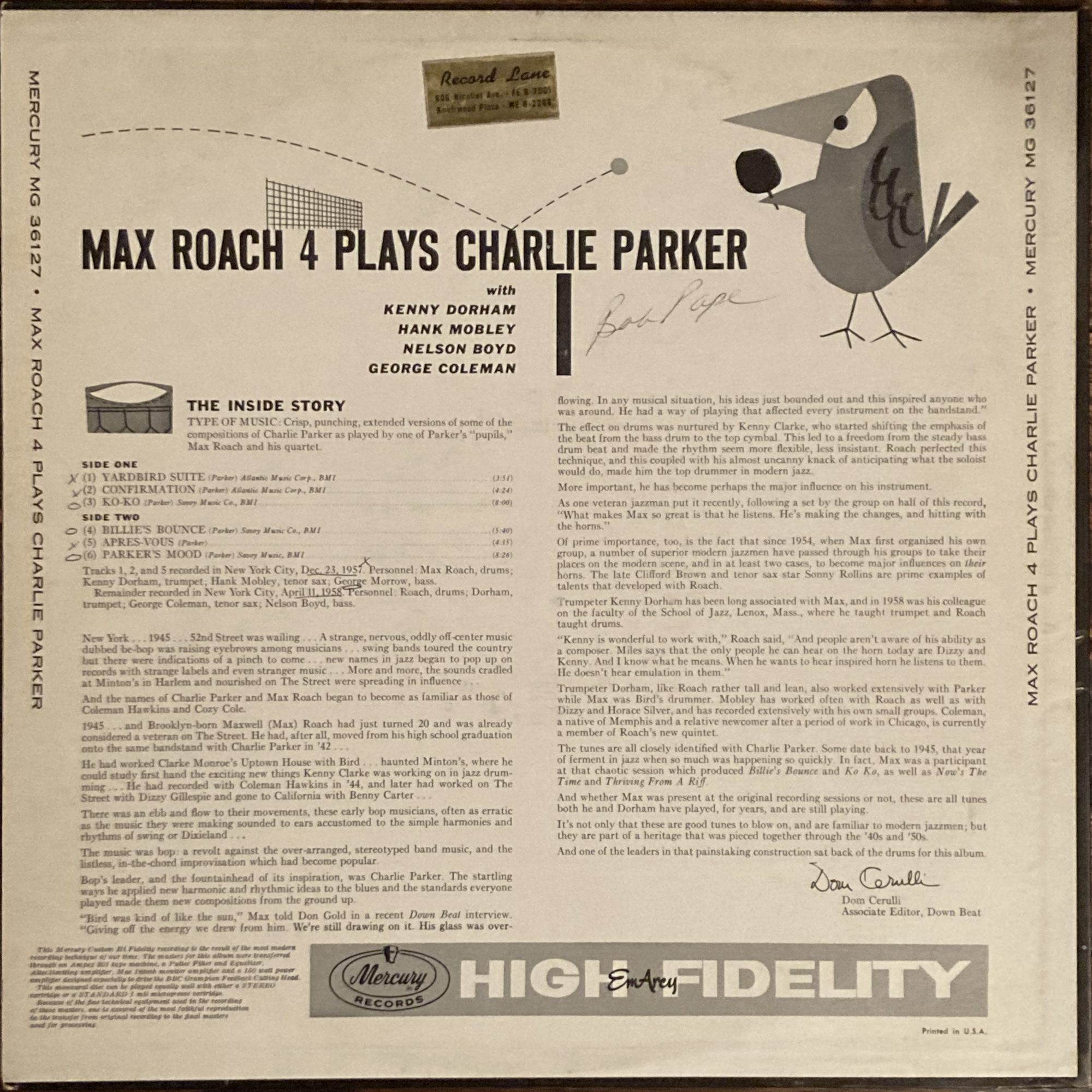
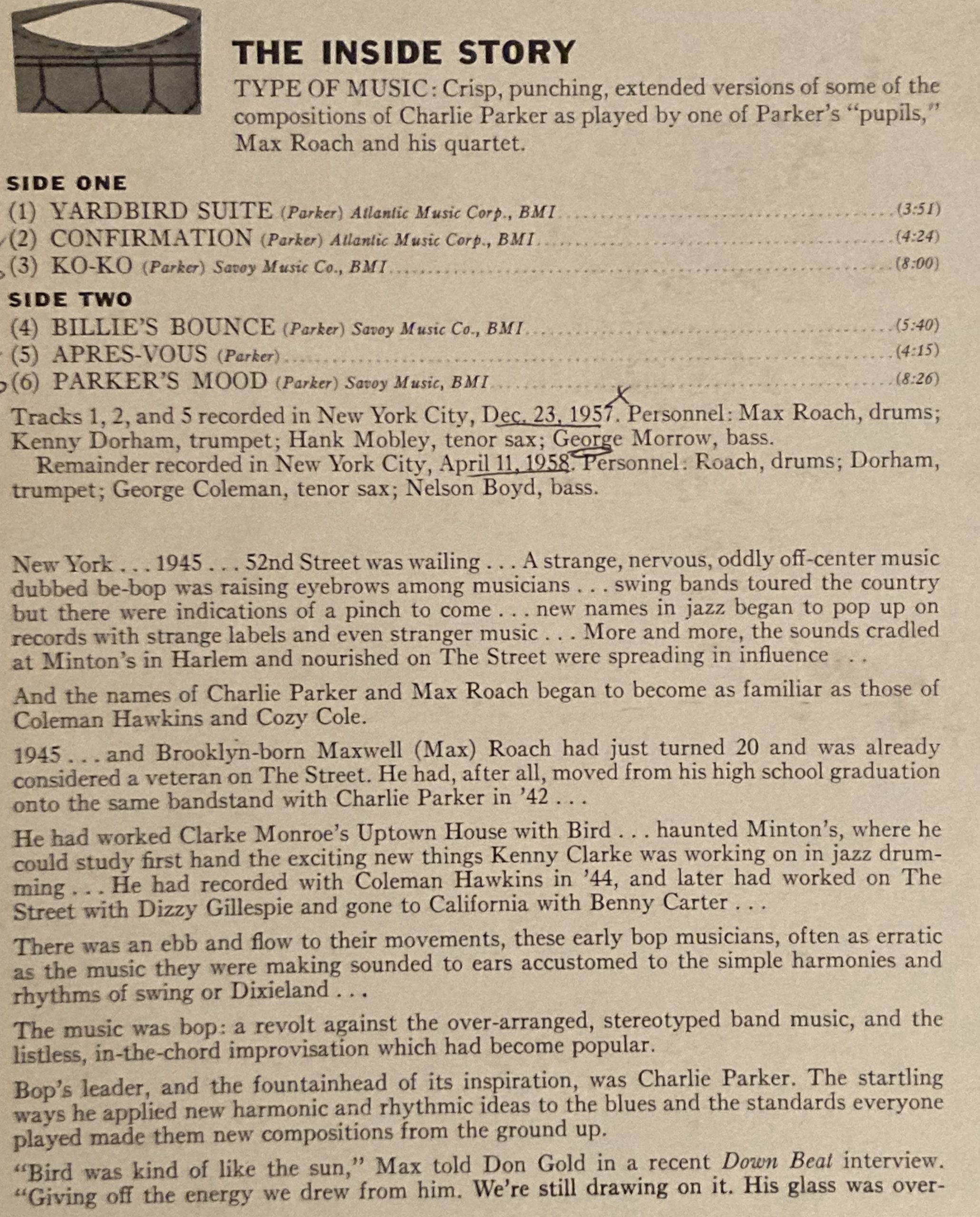
<裏ジャケ原文>
THE INSIDE STORY
TYPE OF MUSIC: Crisp, punching, extended versions of some of the compositions of Charlie Parker as played by one of Parker’s “pupils,” Max Roach and his quartet.
SIDE ONE
(1) YARDBIRD SUITE (Parker) Atlantic Music Corp., BMI……(3:51)
(2) CONFIRMATION (Parker) Atlantic Music Corp., BMI. ….(4:24)
(3) KO-KO (Parker) Savoy Music Co., BMI ….(8:00)
SIDE TWO
(4) BILLIE’S BOUNCE (Parker) Savoy Music Co., BMI…(5:40)
(5) APRES-VOUS (Parker)……(4:15)
5(6) PARKER’S MOOD (Parker) Savoy Music, BMI…(8:26)
Tracks 1, 2, and 5 recorded in New York City, Dec. 23, 1957. Personnel: Max Roach, drums; Kenny Dorham, trumpet; Hank Mobley, tenor sax; George Morrow, bass.
Remainder recorded in New York City, April 11, 1958. Personnel: Roach, drums; Dorham, trumpet; George Coleman, tenor sax; Nelson Boyd, bass.
New York…1945… 52nd Street was wailing… A strange, nervous, oddly off-center music dubbed be-bop was raising eyebrows among musicians swing bands toured the country but there were indications of a pinch to come… new names in jazz began to pop up on records with strange labels and even stranger music… More and more, the sounds cradled at Minton’s in Harlem and nourished on The Street were spreading in influence
And the names of Charlie Parker and Max Roach began to become as familiar as those of Coleman Hawkins and Cozy Cole.
1945…and Brooklyn-born Maxwell (Max) Roach had just turned 20 and was already considered a veteran on The Street. He had, after all, moved from his high school graduation onto the same bandstand with Charlie Parker in ’42…
He had worked Clarke Monroe’s Uptown House with Bird… haunted Minton’s, where he could study first hand the exciting new things Kenny Clarke was working on in jazz drum- ming. He had recorded with Coleman Hawkins in ’44, and later had worked on The Street with Dizzy Gillespie and gone to California with Benny Carter…
There was an ebb and flow to their movements, these early bop musicians, often as erratic as the music they were making sounded to ears accustomed to the simple harmonies and rhythms of swing or Dixieland…
The music was bop: a revolt against the over-arranged, stereotyped band music, and the listless, in-the-chord improvisation which had become popular.
Bop’s leader, and the fountainhead of its inspiration, was Charlie Parker. The startling ways he applied new harmonic and rhythmic ideas to the blues and the standards everyone played made them new compositions from the ground up.
“Bird was kind of like the sun,” Max told Don Gold in a recent Down Beat interview. “Giving off the energy we drew from him. We’re still drawing on it. His glass was over-flowing. In any musical situation, his ideas just bounded out and this inspired anyone who was around. He had a way of playing that affected every instrument on the bandstand.” The effect on drums was nurtured by Kenny Clarke, who started shifting the emphasis of the beat from the bass drum to the top cymbal. This led to a freedom from the steady bass drum beat and made the rhythm seem more flexible, less insistant. Roach perfected this technique, and this coupled with his almost uncanny knack of anticipating what the soloist would do, made him the top drummer in modern jazz.
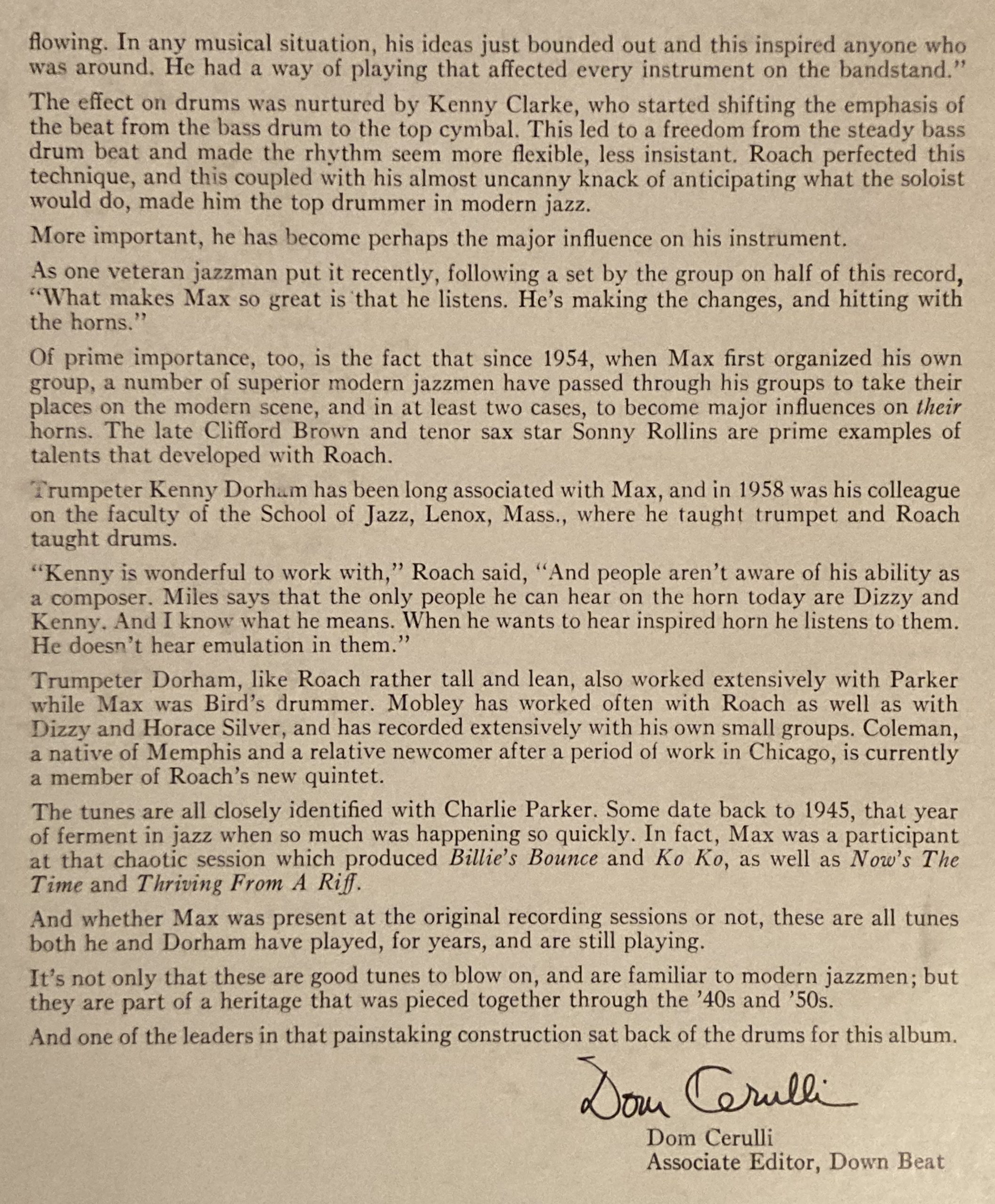
More important, he has become perhaps the major influence on his instrument.
As one veteran jazzman put it recently, following a set by the group on half of this record, “What makes Max so great is that he listens. He’s making the changes, and hitting with the horns.”
Of prime importance, too, is the fact that since 1954, when Max first organized his own group, a number of superior modern jazzmen have passed through his groups to take their places on the modern scene, and in at least two cases, to become major influences on their horns. The late Clifford Brown and tenor sax star Sonny Rollins are prime examples of talents that developed with Roach.
Trumpeter Kenny Dorham has been long associated with Max, and in 1958 was his colleague on the faculty of the School of Jazz, Lenox, Mass., where he taught trumpet and Roach taught drums.
“Kenny is wonderful to work with,” Roach said, “And people aren’t aware of his ability as a composer. Miles says that the only people he can hear on the horn today are Dizzy and Kenny. And I know what he means. When he wants to hear inspired horn he listens to them. He doesn’t hear emulation in them.”
Trumpeter Dorham, like Roach rather tall and lean, also worked extensively with Parker while Max was Bird’s drummer. Mobley has worked often with Roach as well as with Dizzy and Horace Silver, and has recorded extensively with his own small groups. Coleman, a native of Memphis and a relative newcomer after a period of work in Chicago, is currently a member of Roach’s new quintet.
The tunes are all closely identified with Charlie Parker. Some date back to 1945, that year of ferment in jazz when so much was happening so quickly. In fact, Max was a participant at that chaotic session which produced Billie’s Bounce and Ko Ko, as well as Now’s The Time and Thriving From A Riff.
And whether Max was present at the original recording sessions or not, these are all tunes both he and Dorham have played, for years, and are still playing.
It’s not only that these are good tunes to blow on, and are familiar to modern jazzmen; but they are part of a heritage that was pieced together through the ’40s and ’50s.
And one of the leaders in that painstaking construction sat back of the drums for this album.
Dom Cerulli
Dom Cerulli
Associate Editor, Down Beat
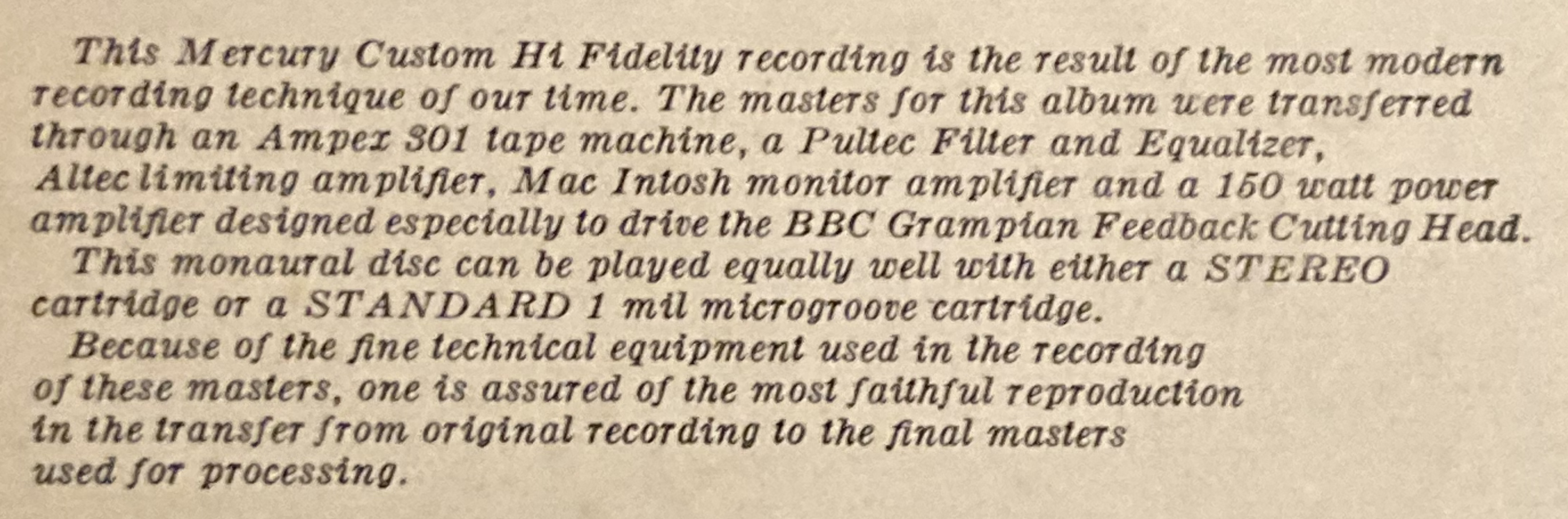
This Mercury Custom Hi Fidelity recording is the result of the most modern recording technique of our time. The masters for this album were transferred through an Amper 301 tape machine, a Pultec Filter and Equalizer, Altec limiting amplifier, Mac Intosh monitor amplifier and a 150 watt power amplifier designed especially to drive the BBC Grampian Feedback Cutting Head. This monaural disc can be played equally well with either a STEREO cartridge or a STANDARD 1 mil microgroove cartridge.
Because of the fine technical equipment used in the recording
of these masters, one is assured of the most faithful reproduction in the transfer from original recording to the final masters used for processing.
<裏ジャケ和訳>
背景にある物語
音楽のスタイル:チャーリー・パーカーの楽曲を、彼の「教え子」の一人であるマックス・ローチが自身のカルテットで演奏。歯切れが良く、力強く、原曲を拡張した構成となっている。
A面
(1) YARDBIRD SUITE (Parker) Atlantic Music Corp., BMI……(3:51)
(2) CONFIRMATION (Parker) Atlantic Music Corp., BMI. ….(4:24)
(3) KO-KO (Parker) Savoy Music Co., BMI ….(8:00)
B面
(4) BILLIE’S BOUNCE (Parker) Savoy Music Co., BMI…(5:40)
(5) APRES-VOUS (Parker)……(4:15)
(6) PARKER’S MOOD (Parker) Savoy Music, BMI…(8:26)
1、2、5曲目は1957年12月23日、ニューヨーク市にて録音。メンバー:マックス・ローチ(ドラムス)、ケニー・ドーハム(トランペット)、ハンク・モブレー(テナー・サックス)、ジョージ・モロー(ベース)。
その他の曲は1958年4月11日、ニューヨーク市にて録音。メンバー:マックス・ローチ(ドラムス)、ケニー・ドーハム(トランペット)、ジョージ・コールマン(テナー・サックス)、ネルソン・ボイド(ベース)。
1945年のニューヨーク……52丁目(52nd Street)は熱気に包まれていた。「ビバップ」と呼ばれる、奇妙で神経質、どこか風変わりな音楽が、当時のミュージシャンたちの間で驚きをもって迎えられていた。スウィング・バンドが全米を巡業していた時代だったが、やがて訪れる苦境の予兆も感じられた。ジャズの世界に新しい名前が登場し始め、見慣れないレーベルから、さらに奇妙な音楽がレコードとしてリリースされるようになった。ハーレムの「ミントンズ(Minton’s)」で産声を上げ、52丁目で育まれたサウンドは、次第にその影響力を広げていった。
そして、チャーリー・パーカーやマックス・ローチといった名前が、コールマン・ホーキンスやコージー・コールといった大物たちと同じくらい、広く知られるようになっていった。
1945年――ブルックリン生まれのマックスウェル(マックス)・ローチは、20歳になったばかりでありながら、すでに52丁目ではベテランと見なされていた。彼は、高校を卒業して間もない1942年には、すでにチャーリー・パーカーと同じステージに立っていた……。
彼は「バード(チャーリー・パーカーの愛称)」と共にクラーク・モンローの「アップタウン・ハウス」で演奏し、ミントンズ・プレイハウスにも足繁く通った。そこでは、ケニー・クラークがジャズ・ドラミングの分野で試みていた刺激的で新しい手法を、直接目の当たりにすることができた。1944年にはコールマン・ホーキンスとレコーディングを行い、その後はディジー・ガレスピーと共に「ザ・ストリート(52丁目)」で活動し、ベニー・カーターに同行してカリフォルニアへも渡った……。
こうした初期のバップ・ミュージシャンたちの動きには、潮の満ち引きのような流動性があった。その動きは、スウィングやディキシーランドの単純なハーモニーやリズムに慣れ親しんだ耳には、彼らが奏でる音楽そのものと同じくらい、予測不可能で風変わりなものに映ったことだろう……。
彼らが奏でた音楽、それが「バップ」である。それは、過度にアレンジされたステレオタイプなバンド音楽や、当時流行していた、ただコード進行をなぞるだけの生気のない即興演奏に対する反乱であった。
ビバップのリーダーであり、そのインスピレーションの源泉となったのはチャーリー・パーカーだった。彼がブルースや誰もが演奏するスタンダード・ナンバーに対して、斬新な和声的・リズム的アイデアを驚くべき手法で適用したことで、それらの楽曲は根底から全く新しい作品へと生まれ変わった。
「バード(チャーリー・パーカーの愛称)は、いわば太陽のような存在だった」と、マックス・ローチは最近の『ダウン・ビート』誌のインタビューでドン・ゴールドに語っている。「彼はエネルギーを放ち、私たちはそこから力を得ていた。今でも私たちはその恩恵を受けている。彼の器からは、エネルギーが溢れ出していたんだ。どんな演奏の場であっても、彼のアイデアは次から次へと飛び出し、周囲の誰をも刺激した。彼の演奏には、ステージ上のあらゆる楽器に影響を与える力があった」。ドラムスに対するその影響はケニー・クラークによって発展させられた。クラークは、ビートの重点をバスドラムからトップ・シンバルへと移し始めたのである。これにより、絶え間なく打ち鳴らされるバスドラムの制約から解放され、リズムはより柔軟で、押し付けがましさのないものとなった。ローチはこの技法を完成の域にまで高めた。さらに、ソリストが次に何をするかを予見する驚異的な才能も相まって、彼はモダン・ジャズ界最高のドラマーとなった。
さらに重要なことに、彼は自身の楽器(ドラムス)において、おそらく最も大きな影響力を持つ存在となったのである。
本レコードの半分を占めるグループの演奏を聴いたあるベテラン・ジャズ・ミュージシャンは、最近こう評した。「マックスの偉大な点は、彼が『聴いている』ということだ。彼はコード進行を把握し、管楽器のフレーズに合わせて的確に反応している」。
また、非常に重要な事実として、1954年にマックスが自身のグループを結成して以来、数多くの優れたモダン・ジャズ・ミュージシャンがそのグループを巣立ち、モダン・ジャズ・シーンで活躍するようになったことが挙げられる。その中には、それぞれの楽器において大きな影響力を持つに至った人物も少なくとも二人いる。故クリフォード・ブラウンやテナー・サックスのスターであるソニー・ロリンズは、ローチのもとで才能を開花させた代表的な例だ。
トランペット奏者のケニー・ドーハムも長年にわたってマックスと親交があり、1958年にはマサチューセッツ州レノックスにある「スクール・オブ・ジャズ」で共に教鞭をとった。そこではドーハムがトランペットを、ローチがドラムスを指導していた。 「ケニーと一緒に演奏するのは最高だよ」とローチは語る。「それに、作曲家としての彼の才能は、あまり知られていない。マイルスは、今日、ホーン奏者の中で『聴くに値する』のはディジーとケニーだけだと言っている。その意味はよくわかる。マイルスは、インスピレーションに満ちたホーンの演奏を聴きたいとき、彼らの音楽を手に取るんだ。彼らの演奏には、単なる模倣など微塵も感じられないからね」
トランペット奏者のドーハムは、ローチと同様に背が高く痩せ型で、マックスが「バード」(チャーリー・パーカー)のドラマーを務めていた時期、彼もまたパーカーと頻繁に共演していた。モブレイはローチとの共演が多いほか、ディジー・ガレスピーやホレス・シルバーとも活動を共にしており、自身の小編成グループでも数多くのレコーディングを行っている。メンフィス出身のコールマンは、シカゴでの活動を経てシーンに登場した比較的新しい顔ぶれだが、現在はローチが結成した新しいクインテットのメンバーである。
ここに収録された楽曲は、いずれもチャーリー・パーカーと深く結びついている。中には1945年に遡るものもある。ジャズ界が激動し、目まぐるしい変化が次々と起こったあの年だ。実際、マックスは『ビリーズ・バウンス(Billie’s Bounce)』や『コ・コ(Ko Ko)』、『ナウズ・ザ・タイム(Now’s The Time)』、『スライヴィング・フロム・ア・リフ(Thriving From A Riff)』といった名曲が生まれた、あの混沌としたセッションにも参加していた。
マックスが当時のオリジナル・レコーディングに立ち会っていたかどうかはさておき、これらの楽曲は、彼とドーハムが長年にわたって演奏し続けてきたレパートリーであり、今もなお演奏され続けているものばかりである。
これらは単に、ジャズミュージシャンにとって即興演奏(ブロウ)しやすく、馴染み深いというだけではない。1940年代から1950年代にかけて築き上げられた、ジャズの遺産の一部なのである。
そして、その丹念な構築の立役者の一人が、本作でドラムセットの背後に座っているのだ。
ドム・セルリ
『ダウン・ビート』誌 アソシエイト・エディター
本作『マーキュリー・カスタム・ハイ・フィデリティ』は、当時の最先端レコーディング技術を駆使して制作された。マスター音源の転送には、アンペックス(Ampex)301テープレコーダー、パルテック(Pultec)製フィルターおよびイコライザー、アルテック(Altec)製リミッティング・アンプ、マッキントッシュ(McIntosh)製モニター・アンプが使用された。さらに、BBCグランピアン(BBC Grampian)社製フィードバック・カッティング・ヘッドを駆動するために特別設計された150ワットのパワーアンプも導入されている。このモノラル・ディスクは、ステレオ用カートリッジ、あるいは標準的な1ミル・マイクログルーブ用カートリッジのいずれを用いても、同様に良好な再生が可能です。
マスター録音の制作には高度な技術機器が使用されており、オリジナル録音から最終的な製造用マスターへと移行する過程において、極めて忠実な再現が保証されています。
※訳文の制作にはGoogleドライブとGoogle翻訳のお世話になりました。
コメント